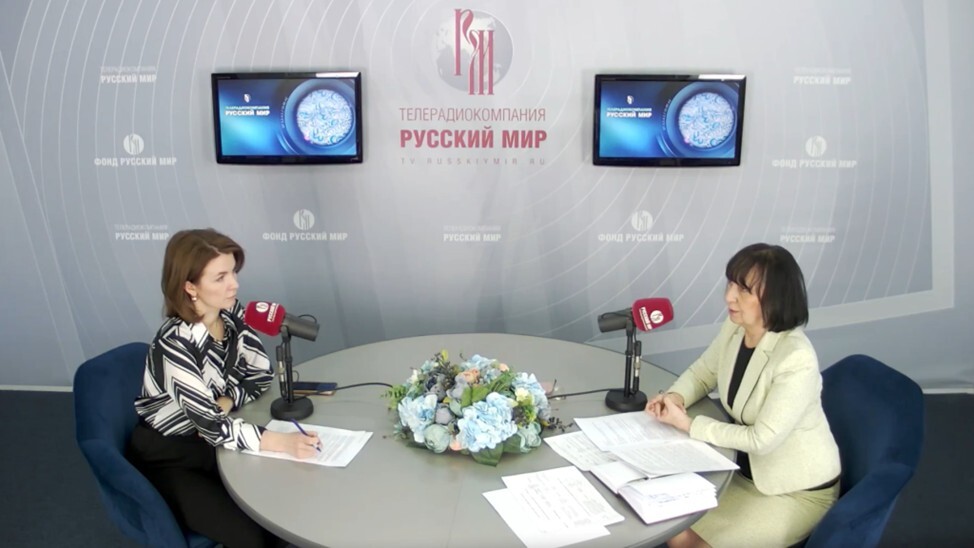
A live broadcast took place on the “Russkiy Mir” TV channel with the Foundation’s Executive Director, Tatyana Shlychkova, on 7th April. She summed up the results of 2025, spoke about new projects, and answered questions from viewers in China, Colombia, Australia, Italy, and other countries.
In conditions of sanctions pressure, logistical restrictions, and a targeted campaign to “cancel” Russian culture, the Foundation has not only maintained but also expanded its global presence. 912 supported projects, 300 foreign guests from 105 countries at the Russkiy Mir Assembly, the launch of multilingual content and the establishment of the first Vitaly Kostomarov Prize in the history of the Foundation - these and other points formed the basis of a frank hour-and-a-half dialogue.
Opening the meeting, Tatyana Shlychkova highlighted the main innovation: from now on, live broadcasts with the Foundation’s leadership will become regular. “They will allow us to maintain a constant exchange of information, respond promptly and adjust our plans,” she explained. For an organisation accustomed to working through diplomatic channels and academic conferences, this step represents a shift in its communication paradigm. Monologue is giving way to dialogue. The first attempt proved successful: given the volume and geographical diversity of the questions received (from China, Serbia, Uzbekistan, Colombia and Australia), the new format is indeed in demand.
Figures and meanings: results of 2025
The main quantitative result is that in 2025 the Foundation supported 912 projects and events across the world. This is significantly more than the previous year. This was achieved under conditions in which logistics and financial transactions had become “challenging”, as the Executive Director carefully phrased it. The qualitative breakthrough concerns geography. The Russkiy Mir Assembly brought together 300 guests from 105 countries. Moreover, the composition of participants has changed fundamentally. Previously, the Foundation’s audience consisted mainly of those who already spoke Russian. Now the focus is on those who do not yet speak Russian but are ready to develop humanitarian cooperation with Russia. “Not only those who already know the Russian language, but also those who simply wish to develop humanitarian cooperation with Russia should take part in the Foundation’s key events,” emphasised Tatyana Shlychkova.
The Foundation has launched a major content translation programme precisely for this audience. English and French are already up and running. Spanish will launch in the second half of the year, with Arabic planned after that. The Foundation’s information resources are transforming from a national archive into a global multilingual platform.
Among other achievements of the past year are the expansion of the network of language camps, professional skill competitions for teachers of Russian as a foreign language, and systematic work with translators. “The translation of Russian literature into foreign languages and the high-quality work of translators means conveying accurate and reliable information,” - summarised Tatyana Shlychkova.
For the first time in the Foundation’s history, a final declaration was adopted following the 2025 Assembly. The document proved to be extensive, as it incorporated the 'long-standing concerns' of many years. “Undoubtedly, the declaration contains a great many questions whose resolution falls within the competence of state bodies: the Ministry of Foreign Affairs, the Ministry of Education, the Ministry of Culture, and Rossotrudnichestvo,” - explained the Executive Director. The Russkiy Mir Foundation does not act as a substitute for the state but rather serves as an operator and catalyst. Nevertheless, several key points were successfully implemented independently.
A system of incentives and recognition has been established. The Lyudmila Verbitskaya Scholarship for foreign students studying Russian philology in Russia has been introduced. And most importantly, the Russkiy Mir Foundation has instituted the Vitaly Kostomarov Award for contribution to international Russian studies. “We now have the very tool that allows us to recognise the achievements of our respected colleagues - foreign teachers, specialists in Russian philology, and translators,” - stated T. V. Shlychkova. The first laureates will be announced at the end of 2026.
A programme of internships and creative internships for foreign translators of Russian literature has been launched. The Foundation has signed agreements with the Moscow State Linguistic University (MSLU), the Higher School of Translation and Interpreting at Lomonosov Moscow State University, and the Herzen State Pedagogical University of Russia. This year, 10 to12 foreign translators will be accepted for internships at Moscow State University.
The implementation of joint educational programmes for journalists has commenced. The first group of foreign journalists will go to the base of the Journalism Department at Irkutsk State University. “If everything goes well, we will expand the programme next year,” - promised Tatyana Shlychkova.
Books and teaching materials: how to gain support
Answering a question about the supply of literature, Tatyana Shlychkova clarified the principles of the Foundation’s work in this area. The Foundation does not have ready-made sets of books and textbooks for mass distribution. “We focus on your specific request,” - she emphasised. Partners are invited to select the necessary literature themselves from three main publishers specialising in Russian as a Foreign Language (RFL). The Foundation purchases works of fiction according to specific titles. Various channels are used for delivery: from the assistance of diplomatic missions to air cargo. Furthermore, the Foundation continues to connect organisations to the electronic library for Russian as a foreign language.
Sanctions and attempts to cancel Russian culture
During the broadcast, the issue of working under conditions of sanctions pressure and attempts to “cancel everything Russian” was raised. Tatyana Shlychkova reminded viewers that the Foundation itself is under sanctions from unfriendly countries, and that the financing of projects has become more complicated and requires more time and effort. Nevertheless, the strategy remains unchanged. “No matter how much one tries to prohibit something, the real thing will still be in demand. Our language, our culture and our literature are part of world culture,” - she stated.
The emphasis has shifted towards cultural and educational projects: Russian language festivals, art competitions, and children’s camps with a language component. These formats are difficult to prohibit because they are in demand by ordinary people - even in unfriendly countries. As an example, Shlychkova cited the “Romansiada” and “Rising Stars” projects, which draw audiences in the Balkans, Europe and Africa.
Work in Central Asia
Priority areas cooperation with Central Asian countries were discussed during the broadcast. In Kyrgyzstan, for instance, the Russian language holds official status alongside Kyrgyz, which creates a solid foundation for work.
Among the key areas is the professional development of teachers of Russian as a foreign language, which can be conducted either locally or online, as well as through visits to Russia. The second area is Russian language instruction: online courses from leading Russian universities, classes held at Russian centres, and specialised courses - for instance, employees of the Ministry of Internal Affairs of Serbia, at the request of the Serbian side. The third area is the “Professor of the Russian World” programme, under which a highly qualified expert is sent to a foreign university for two to three weeks. T. V. Shlychkova clarified that a “professor” is not limited to philologists. Under the programme, specialists in geological exploration, nuclear energy, or creative disciplines may also take part provided this leads to increased interest in the Russian language and culture. However, specialists in Russian language and literature receive considerably greater support, “because this is our main task and primary goal,” - she stressed.
Moreover, an online programme leading to a second diploma as a teacher of Russian as a Foreign Language (RFL) is being implemented jointly with Saint Petersburg State University. “It is a demanding programme and not everyone completes it, but there have been successful experiences,” - noted Tatyana Shlychkova.
In addition to traditional festivals and professional development courses, the Executive Director highlighted scientific and practical conferences, where specialists in Russian philology from various countries exchange experience and raise long-standing concerns. In response to this demand, the Foundation will hold five regional conferences in 2026: in Central Asia, Asia, Africa, Latin America, and Europe. These events are part of the preparation for the Foundation’s anniversary and the Russkiy Mir Assembly in 2027. Such “cluster” meetings, as Shlychkova called them, make it possible to discuss specific issues of translation and methodology, and subsequently to incorporate the best solutions into the programme of the main annual event.
Grant programme: criteria, experts and common mistakes
A question concerning the principles of project support was raised during the broadcast. Tatyana Shlychkova explained the process in detail. Firstly, it is essential to distinguish clearly between two categories: “promotion of the Russian language” (educational) and “cultural and humanitarian”. Choosing the wrong category leads to a lowering of the experts' assessment. Secondly, the experts are independent - they do not work for the Foundation. The decision to support a project is based on their rating and is then approved by the Board, which also does not include Foundation staff. Thirdly, the most common problem is an unrealistic estimate. “A project costing 10–12 million roubles, given that our usual grant ranges from 200,000 to 1.3 million, is simply unrealistic. Even with a high rating, it will not be approved,” - notified Tatyana Shlychkova. Fourthly, the Foundation does not fund the purchase of equipment nor the ongoing statutory activities of organisations, but it may cover the cost of renting premises, hiring equipment, travel, accommodation, and logistics.
One of the questions came from Colombia. It was asked whether it would be possible to invite musicians who play Russian folk instruments. Tatyana Shlychkova explained that the “Rising Stars” project, which the Foundation implements jointly with the Moscow State Tchaikovsky Conservatory, has already visited Colombia twice. These are royalty-free tours featuring young talents: the Foundation covers travel expenses, while the embassy assists with venues and accommodation. According to the Executive Director, the Gnesin Academy with its Department of Folk Instruments will join the project from next year. “One can perform anything on the balalaika or domra - from Russian folk music to Khachaturian or a Chopin waltz. If you close your eyes, you won’t be able to tell the difference between a symphony orchestra and our ensemble,” - she said, citing the Osipov State Russian Folk Orchestra as an example. Colombia will once again be included in the tour schedule in 2027 if the embassy submits a request.
The hour-and-a-half live broadcast clearly demonstrated that the Russkiy Mir Foundation is undergoing a systemic transformation. It is moving away from simply supplying books and issuing grants towards becoming an intellectual and cultural hub operating on the principles of “smart power”. The translation of content into major world languages, the Kostomarov Prize for foreign Russian studies scholars, internships for translators, visiting sessions by professors, regional conferences, and the «Rising Stars» project - all of these initiatives demonstrate the organisation’s evolution and its ability to adapt to new realities. Sanctions and Russophobia have not eliminated the demand for Russian culture. They have merely changed the logistics and forms of engagement. “Whatever the relations between official authorities may be, peoples must have the opportunity to learn new things and draw their own conclusions,” - said Tatyana Shlychkova in conclusion.
The next live broadcast is scheduled for the summer.
In conditions of sanctions pressure, logistical restrictions, and a targeted campaign to “cancel” Russian culture, the Foundation has not only maintained but also expanded its global presence. 912 supported projects, 300 foreign guests from 105 countries at the Russkiy Mir Assembly, the launch of multilingual content and the establishment of the first Vitaly Kostomarov Prize in the history of the Foundation - these and other points formed the basis of a frank hour-and-a-half dialogue.
Opening the meeting, Tatyana Shlychkova highlighted the main innovation: from now on, live broadcasts with the Foundation’s leadership will become regular. “They will allow us to maintain a constant exchange of information, respond promptly and adjust our plans,” she explained. For an organisation accustomed to working through diplomatic channels and academic conferences, this step represents a shift in its communication paradigm. Monologue is giving way to dialogue. The first attempt proved successful: given the volume and geographical diversity of the questions received (from China, Serbia, Uzbekistan, Colombia and Australia), the new format is indeed in demand.
Figures and meanings: results of 2025
The main quantitative result is that in 2025 the Foundation supported 912 projects and events across the world. This is significantly more than the previous year. This was achieved under conditions in which logistics and financial transactions had become “challenging”, as the Executive Director carefully phrased it. The qualitative breakthrough concerns geography. The Russkiy Mir Assembly brought together 300 guests from 105 countries. Moreover, the composition of participants has changed fundamentally. Previously, the Foundation’s audience consisted mainly of those who already spoke Russian. Now the focus is on those who do not yet speak Russian but are ready to develop humanitarian cooperation with Russia. “Not only those who already know the Russian language, but also those who simply wish to develop humanitarian cooperation with Russia should take part in the Foundation’s key events,” emphasised Tatyana Shlychkova.
The Foundation has launched a major content translation programme precisely for this audience. English and French are already up and running. Spanish will launch in the second half of the year, with Arabic planned after that. The Foundation’s information resources are transforming from a national archive into a global multilingual platform.
Among other achievements of the past year are the expansion of the network of language camps, professional skill competitions for teachers of Russian as a foreign language, and systematic work with translators. “The translation of Russian literature into foreign languages and the high-quality work of translators means conveying accurate and reliable information,” - summarised Tatyana Shlychkova.
For the first time in the Foundation’s history, a final declaration was adopted following the 2025 Assembly. The document proved to be extensive, as it incorporated the 'long-standing concerns' of many years. “Undoubtedly, the declaration contains a great many questions whose resolution falls within the competence of state bodies: the Ministry of Foreign Affairs, the Ministry of Education, the Ministry of Culture, and Rossotrudnichestvo,” - explained the Executive Director. The Russkiy Mir Foundation does not act as a substitute for the state but rather serves as an operator and catalyst. Nevertheless, several key points were successfully implemented independently.
A system of incentives and recognition has been established. The Lyudmila Verbitskaya Scholarship for foreign students studying Russian philology in Russia has been introduced. And most importantly, the Russkiy Mir Foundation has instituted the Vitaly Kostomarov Award for contribution to international Russian studies. “We now have the very tool that allows us to recognise the achievements of our respected colleagues - foreign teachers, specialists in Russian philology, and translators,” - stated T. V. Shlychkova. The first laureates will be announced at the end of 2026.
A programme of internships and creative internships for foreign translators of Russian literature has been launched. The Foundation has signed agreements with the Moscow State Linguistic University (MSLU), the Higher School of Translation and Interpreting at Lomonosov Moscow State University, and the Herzen State Pedagogical University of Russia. This year, 10 to12 foreign translators will be accepted for internships at Moscow State University.
The implementation of joint educational programmes for journalists has commenced. The first group of foreign journalists will go to the base of the Journalism Department at Irkutsk State University. “If everything goes well, we will expand the programme next year,” - promised Tatyana Shlychkova.
Books and teaching materials: how to gain support
Answering a question about the supply of literature, Tatyana Shlychkova clarified the principles of the Foundation’s work in this area. The Foundation does not have ready-made sets of books and textbooks for mass distribution. “We focus on your specific request,” - she emphasised. Partners are invited to select the necessary literature themselves from three main publishers specialising in Russian as a Foreign Language (RFL). The Foundation purchases works of fiction according to specific titles. Various channels are used for delivery: from the assistance of diplomatic missions to air cargo. Furthermore, the Foundation continues to connect organisations to the electronic library for Russian as a foreign language.
Sanctions and attempts to cancel Russian culture
During the broadcast, the issue of working under conditions of sanctions pressure and attempts to “cancel everything Russian” was raised. Tatyana Shlychkova reminded viewers that the Foundation itself is under sanctions from unfriendly countries, and that the financing of projects has become more complicated and requires more time and effort. Nevertheless, the strategy remains unchanged. “No matter how much one tries to prohibit something, the real thing will still be in demand. Our language, our culture and our literature are part of world culture,” - she stated.
The emphasis has shifted towards cultural and educational projects: Russian language festivals, art competitions, and children’s camps with a language component. These formats are difficult to prohibit because they are in demand by ordinary people - even in unfriendly countries. As an example, Shlychkova cited the “Romansiada” and “Rising Stars” projects, which draw audiences in the Balkans, Europe and Africa.
Work in Central Asia
Priority areas cooperation with Central Asian countries were discussed during the broadcast. In Kyrgyzstan, for instance, the Russian language holds official status alongside Kyrgyz, which creates a solid foundation for work.
Among the key areas is the professional development of teachers of Russian as a foreign language, which can be conducted either locally or online, as well as through visits to Russia. The second area is Russian language instruction: online courses from leading Russian universities, classes held at Russian centres, and specialised courses - for instance, employees of the Ministry of Internal Affairs of Serbia, at the request of the Serbian side. The third area is the “Professor of the Russian World” programme, under which a highly qualified expert is sent to a foreign university for two to three weeks. T. V. Shlychkova clarified that a “professor” is not limited to philologists. Under the programme, specialists in geological exploration, nuclear energy, or creative disciplines may also take part provided this leads to increased interest in the Russian language and culture. However, specialists in Russian language and literature receive considerably greater support, “because this is our main task and primary goal,” - she stressed.
Moreover, an online programme leading to a second diploma as a teacher of Russian as a Foreign Language (RFL) is being implemented jointly with Saint Petersburg State University. “It is a demanding programme and not everyone completes it, but there have been successful experiences,” - noted Tatyana Shlychkova.
In addition to traditional festivals and professional development courses, the Executive Director highlighted scientific and practical conferences, where specialists in Russian philology from various countries exchange experience and raise long-standing concerns. In response to this demand, the Foundation will hold five regional conferences in 2026: in Central Asia, Asia, Africa, Latin America, and Europe. These events are part of the preparation for the Foundation’s anniversary and the Russkiy Mir Assembly in 2027. Such “cluster” meetings, as Shlychkova called them, make it possible to discuss specific issues of translation and methodology, and subsequently to incorporate the best solutions into the programme of the main annual event.
Grant programme: criteria, experts and common mistakes
A question concerning the principles of project support was raised during the broadcast. Tatyana Shlychkova explained the process in detail. Firstly, it is essential to distinguish clearly between two categories: “promotion of the Russian language” (educational) and “cultural and humanitarian”. Choosing the wrong category leads to a lowering of the experts' assessment. Secondly, the experts are independent - they do not work for the Foundation. The decision to support a project is based on their rating and is then approved by the Board, which also does not include Foundation staff. Thirdly, the most common problem is an unrealistic estimate. “A project costing 10–12 million roubles, given that our usual grant ranges from 200,000 to 1.3 million, is simply unrealistic. Even with a high rating, it will not be approved,” - notified Tatyana Shlychkova. Fourthly, the Foundation does not fund the purchase of equipment nor the ongoing statutory activities of organisations, but it may cover the cost of renting premises, hiring equipment, travel, accommodation, and logistics.
One of the questions came from Colombia. It was asked whether it would be possible to invite musicians who play Russian folk instruments. Tatyana Shlychkova explained that the “Rising Stars” project, which the Foundation implements jointly with the Moscow State Tchaikovsky Conservatory, has already visited Colombia twice. These are royalty-free tours featuring young talents: the Foundation covers travel expenses, while the embassy assists with venues and accommodation. According to the Executive Director, the Gnesin Academy with its Department of Folk Instruments will join the project from next year. “One can perform anything on the balalaika or domra - from Russian folk music to Khachaturian or a Chopin waltz. If you close your eyes, you won’t be able to tell the difference between a symphony orchestra and our ensemble,” - she said, citing the Osipov State Russian Folk Orchestra as an example. Colombia will once again be included in the tour schedule in 2027 if the embassy submits a request.
The hour-and-a-half live broadcast clearly demonstrated that the Russkiy Mir Foundation is undergoing a systemic transformation. It is moving away from simply supplying books and issuing grants towards becoming an intellectual and cultural hub operating on the principles of “smart power”. The translation of content into major world languages, the Kostomarov Prize for foreign Russian studies scholars, internships for translators, visiting sessions by professors, regional conferences, and the «Rising Stars» project - all of these initiatives demonstrate the organisation’s evolution and its ability to adapt to new realities. Sanctions and Russophobia have not eliminated the demand for Russian culture. They have merely changed the logistics and forms of engagement. “Whatever the relations between official authorities may be, peoples must have the opportunity to learn new things and draw their own conclusions,” - said Tatyana Shlychkova in conclusion.
The next live broadcast is scheduled for the summer.