
Russian literature in India is a bridge between cultures, a dialogue about the eternal that has been going on for over a century. Dostoevsky, Tolstoy and Chekhov find grateful readers here, and their characters turn out to be surprisingly close to Indian students. But how does the Russian language live in this country today? And what attracts young people more to its study – the charm of culture or career prospects? We spoke about this with Anju Rani, lecturer and Assistant Professor at the Department of Slavonic and Finno-Ugrian Studies of the University of Delhi.
– Do many students choose Russian as a language of study, and what programmes exist today at the University of Delhi?
– Yes, many students choose Russian. The Department of Slavonic and Finno-Ugrian Studies at the University of Delhi offers various programmes: correspondence courses – a certificate course, a diploma, and an advanced diploma; and full-time programmes – an intensive advanced diploma in Russian, a bachelor's degree, a master's degree, and doctoral studies (PhD) in Russian language and literature. At present, more than 200 students are enrolled across all programmes. Compared with other foreign languages, after French, German, and Spanish, Russian ranks fourth in popularity. The number of students studying Russian remains relatively stable, although recent admission data indicate a slight decline in demand.
– What is the main motivation of your students? How do they explain their choice of Russian?
– Students generally choose Russian because they see it as a language of cultural and intellectual interest, as well as a specialised professional skill. For many, the primary goal is to work as a translator. They also see value in careers in tourism, including medical tourism. Some students have a particular interest in Russian literature and want to read Russian literary works in the original; others are fascinated by Russian culture. Still others aim for careers in research, teaching, diplomacy, international relations and organisations connected with Russia. The University of Delhi is especially attractive to students because Russian is taught here as a full academic discipline and offers opportunities for further study and research.
– What are the main difficulties Indian students face when studying Russian? Is there anything they find particularly hard, and what, on the contrary, comes easily?
– When we talk about the difficulties of learning a foreign language in India, I would say that the process is strongly influenced by the students’ initial familiarity with grammatical concepts. Students arrive with different linguistic and educational backgrounds. Those who have only a weak acquaintance with the systematic grammar of Hindi or English find it harder at the beginning to master the complex constructions of Russian. Conversely, those who have a good command of the grammatical system of their mother tongue understand the structure of Russian much more easily.
Students from different regions of India possess varying levels of formal grammatical analysis, and this, too, affects their assimilation of the language. They tend to compare Russian with English and with their native language, using similarities and differences to understand new structures. Multilingualism can be both an advantage and a source of language interference.
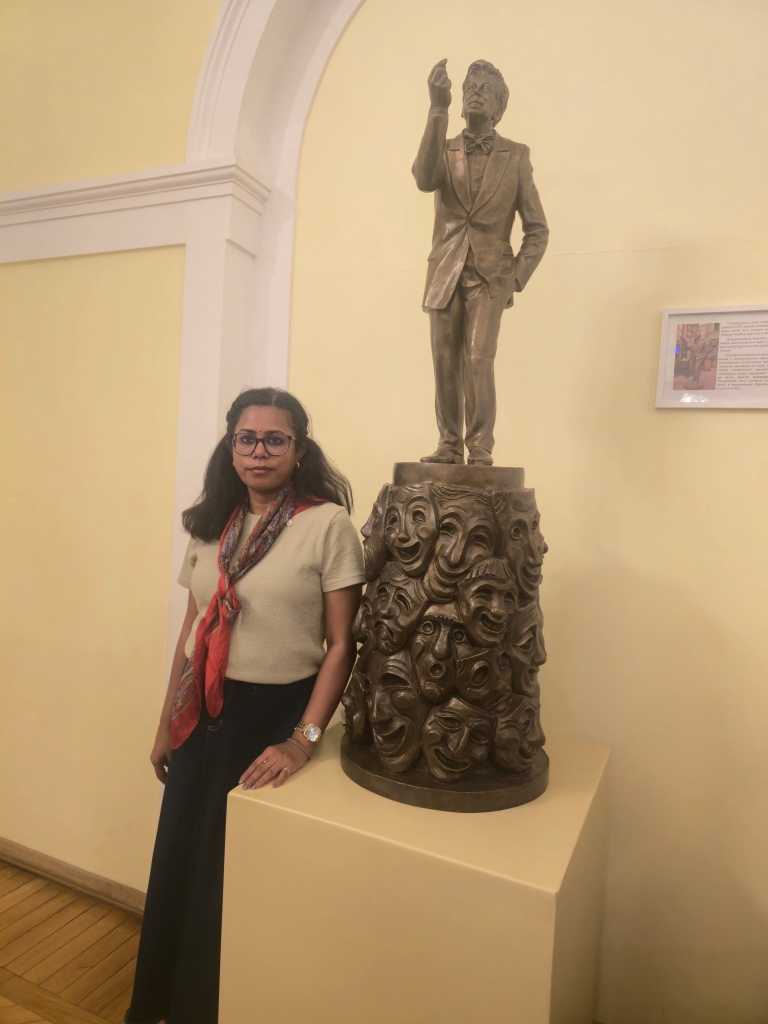
The principal difficulties are the case system, grammatical gender and agreement, aspect of the verb, verbs of motion, the pronunciation of hard and soft consonants, and unpredictable stress. The case system is particularly complex: the choice of case depends on the syntactic role of the word, its meaning, and the governing verb or preposition. At the same time, nouns, adjectives and pronouns must agree with one another. Research confirms that learners of Russian as a second language often struggle with cases and with overcoming the language barrier between Russian and Hindi. Word stress likewise presents challenges: it is not always predictable, and an error in stress may alter the meaning of a word or impede pronunciation.
The greatest difficulty often lies not in understanding the rules, but in applying them spontaneously in spoken speech. The Cyrillic alphabet and handwritten text seem complicated at the beginning, but students master reading skills fairly quickly. Multilingual experience is useful for developing phonemic awareness and understanding grammatical structures; however, the influence of English, Hindi and other Indian languages can lead to recurring errors. That is why contrastive teaching, as well as systematic phonetic and communicative practice, is especially important for those learning Russian as a second language.
– In your opinion, is it possible to make the study of Russian more popular among young people in India, and how can this be achieved?
– Yes, I believe it is possible to increase interest in studying Russian among Indian youth if we present it not only as a literary or academic subject, but also as a language of contemporary cultural, professional and international significance. Greater attention should be paid to career opportunities in translation, diplomacy, international relations, tourism, education, the media, business and research. It is also useful to highlight the long-standing cultural, educational, economic and diplomatic ties between India and Russia in order to demonstrate the practical value of the Russian language.
At the same time, teaching methods should become more interactive through the use of films, music, contemporary literature, social media, podcasts, digital resources, and other elements of modern Russian culture. Opportunities for student exchanges, summer and winter schools, internships and interaction with Russian students can further motivate learners. Raising awareness at school level through seminars and language clubs would also encourage students to consider Russian as a subject for university study.
In my view, the main thing is to move beyond the perception of Russian as primarily a literary language and to show that it enriches culture, opens opportunities for international communication, and offers diverse professional prospects.
– You teach not only the language, but also literature. Which Russian authors generate the greatest interest among Indian students and Indian readers in general? And how popular is Russian literature in India today overall?
– Russian literature holds a special place in India, and Indian students and readers continue to show great interest in the Russian classics. Works by such writers as Alexander Pushkin, Nikolai Gogol, Ivan Turgenev, Fyodor Dostoevsky, Leo Tolstoy and Anton Chekhov are particularly popular. These works attract Indian readers because they address eternal themes such as love, morality, social inequality, poverty, human suffering, family, spirituality, and the search for the meaning of life.
also exerted a significant influence upon Indian literary culture through translations and adaptations. For example, Chekhov's stories and dramatic techniques have influenced Indian writers, while Dostoevsky's novella White Nights has been adapted for the Indian stage. Tolstoy attracts readers through his views on society, ethics, non-violence, and human relations, whilst Chekhov is valued for his simple yet profound depictions of ordinary people and everyday life. Pushkin is important not only as the founder of modern Russian literature, but also as a poet whose works acquaint readers with the richness of the Russian language and culture. Considerable interest is likewise aroused by the works of such writers as Maxim Gorky, Anna Akhmatova, and Sergei Yesenin, as well as by contemporary Russian authors, although these are not read so widely.
Russian literature remains relevant in modern India, but the readership has changed. In the nineteenth century, Russian books were widely available in India in English, Hindi, and other Indian languages, and several generations of Indians grew up on Russian literature and children’s books. Today, Russian classics are widely read, particularly at universities and among those with a serious enthusiasm for literature. Contemporary Russian literature, however, is less well known to the broad Indian reading public, chiefly because relatively few modern works have been translated into Indian languages.
Recently, there have been efforts to translate works by contemporary Russian writers, including with the support of the Institute for Literary Translation in Moscow, which is a positive development. However, in my view, these efforts could be strengthened through closer cooperation between Russian and Indian literary and translation organisations. One important way to restore and strengthen literary ties between India and Russia would be to publish more translations of works by contemporary Russian writers directly into Hindi and other Indian languages, rather than translating them only into English. This would make contemporary Russian literature accessible to a much wider readership and would also allow Indian readers to become more familiar with contemporary Russian society, culture, and literary trends. Greater institutional support for translators, publishing houses, literary exchanges, and translation programmes could play an important role in reviving these literary connections.
I believe that Russian literature has a great future in India. Young people are interested in Russian culture, and literature helps them become better acquainted with it. The enduring popularity of the classics can be explained by the fact that they remain in demand, but at the same time there is also a growing interest in translations of contemporary literature.
– Can we draw parallels between Russian and Indian literary traditions? What motifs, themes, or characters resonate particularly strongly with Indian readers?
– Yes, absolutely. It is possible to draw parallels between Russian and Indian literary traditions. Although these traditions developed in completely different historical and cultural contexts, they share a deep interest in human existence, social inequality, morality, spirituality, family, suffering and the relationship between the individual and society. These common themes make Russian literature particularly close to Indian readers.
One important similarity is the attention paid to ordinary people and socially vulnerable groups. Russian writers such as Dostoevsky, Tolstoy, Gogol, and Chekhov often portrayed poor and ordinary people, as well as those who found themselves on the margins of society, with great sympathy. This resonates with the works of Munshi Premchand in Indian literature. Although Premchand, like the Russian writers, worked in a completely different era, he likewise paid particular attention to peasants, workers, the poor, and people living on the margins of society. For instance, interesting parallels can be drawn between Akaky Akakievich from Gogol’s The Overcoat and Horiram from Godaan, as well as between Ghisu and his son Madhav from Kafan. These characters face poverty, social inequality, exploitation, bureaucracy, and society’s indifference.
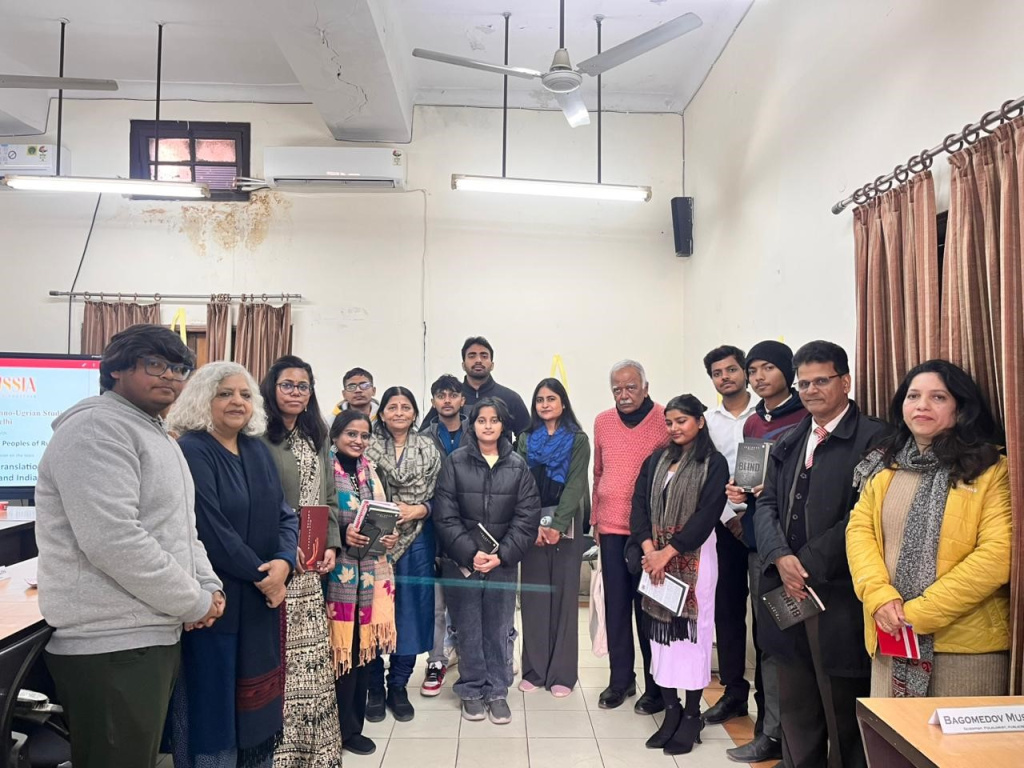
Another important parallel is the search for moral and spiritual meaning. Dostoevsky’s novels explore questions of guilt, suffering, faith, redemption, and moral choice. Similar themes can be found in the works of the Indian writer Nirmal Verma, which often address loneliness, alienation, inner conflict, and the search for the meaning of life. Although these two writers belong to very different cultural and historical contexts, both were deeply interested in the psychological and moral dimensions of human existence.
Tolstoy’s ideas of non-violence, simplicity and moral responsibility also resonated in India and had a significant influence on Mahatma Gandhi. The theme of social injustice and inequality is another common feature. Both Russian and Indian writers have often used literature not simply as entertainment, but as a means of questioning existing social structures and drawing attention to the suffering of ordinary people. This is one of the reasons why writers such as Tolstoy, Dostoevsky, Gorky, and Chekhov continue to attract the attention of Indian readers.
The similarities can also be seen in the portrayal of family, relationships, and the conflict between personal desires and social expectations. Indian readers may identify with characters who find themselves faced with a difficult choice between personal freedom, family responsibilities, and social norms.
A dialogue between Russian and Indian literature is entirely natural. Our historical experiences are different, but many fundamental questions remain the same. Suffering, compassion, social justice, spirituality, human dignity, and the search for the meaning of life are universal themes, and it is precisely their universality that explains why Russian literature continues to find attentive readers in India.
– Tell us about your experience of working with translations. What kind of translations do you undertake? What is lost or gained when Russian prose and poetry are translated into Hindi or English? What difficulties arise in the translation process?
– Literary translation is no easy task, and I mainly work on literary translations from Russian into Hindi and English. I have translated several short stories by Mikhail Zoshchenko, which gave me valuable experience in dealing with cultural differences, humour, irony, and colloquial language.
One of the main challenges is cultural context. For instance, concepts such as a single mother and the institution of marriage may be understood differently in Russian and Indian societies. In addition, in Russian culture, a white wedding dress is traditionally associated with a bride and marriage, whereas in Indian culture, white clothing is traditionally associated with widowhood. Therefore, a literal translation can create a completely different impression on an Indian reader. A translator must understand these cultural differences and convey the meaning intended by the author accurately.
Another difficulty is humour, irony, idiomatic expressions, as well as differences in grammar and syntax. These elements cannot always be translated literally. A translator must preserve not only the meaning, but also the author’s style, tone, and emotional dimension.
As part of the Master’s programme, I also helped my students translate works by Alexander Solzhenitsyn, Victoria Tokareva, and other Russian writers. This became a valuable experience both for my students and for me.
Literary translation is, essentially, a way of building bridges between two languages and cultures. Based on my personal experience, I may say that a good translation remains faithful to the original while also making the text natural and comprehensible to the reader.
– You regularly organise meetings in Delhi with Russian writers, poets, and scholars. Who attends these events, and what attracts them?
– Yes, I regularly organise literary and academic meetings at the University of Delhi with Russian writers, poets, playwrights, translators, scholars, and members of Indian academic circles. Over the years, we have had the opportunity to meet and talk with several prominent figures, including Roman Senchin, a prose writer, editor, and literary critic; Alyona Karimova, a poet, children’s writer, and translator; Yaroslava Pulinovich, a playwright and screenwriter; Ilya Kochergin, a writer, prose author, and editor; Musa Bagomedov, a scholar, folklorist, and essayist; and Irina Kraeva, a writer, journalist, and philologist. From India, we have welcomed Sukrita Paul Kumar, an Indian poet, critic, and scholar, and Ranjana Saxena, a specialist in Russian literature and a translator.
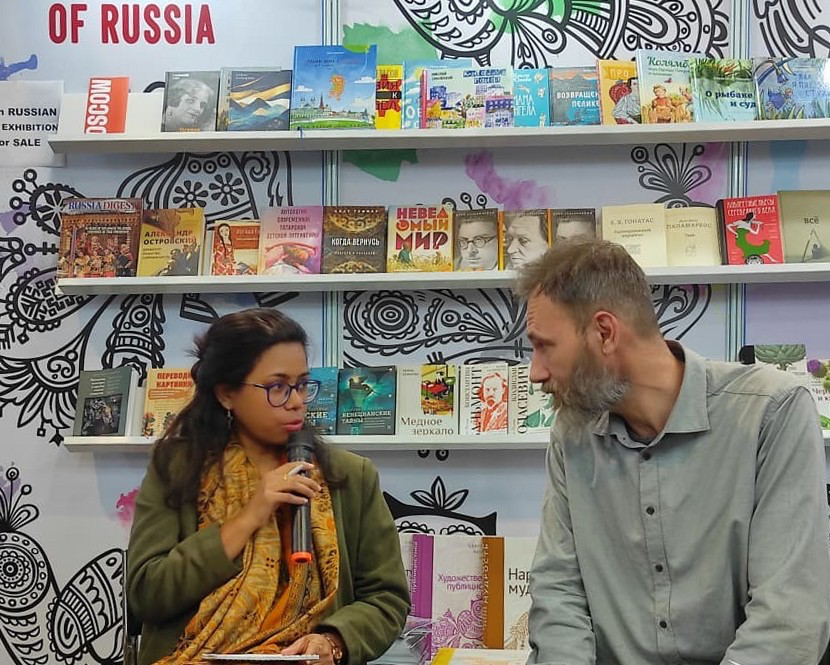
Students, lecturers, researchers, translators, writers, and readers interested in the Russian language and literature attend these meetings. For students, such meetings are a valuable opportunity to communicate with writers in person, ask questions, discuss contemporary literature, and gain a deeper understanding of Russia’s literary and cultural life. These events also play an important role in strengthening literary and cultural dialogue between India and Russia.
– How has this work changed in recent years? Has it become more difficult or, on the contrary, more interesting to invite Russian cultural figures to India? How important is support from your Russian partners to you?
– I think that in recent years this work has become both more challenging and more interesting. There are now more opportunities for direct cultural and academic exchange, although organising visits requires more careful coordination.
The support from Russian partners such as the Russkiy Mir Foundation, Rossotrudnichestvo, and the Embassy of Russia in India is extremely important to me. Thanks to them, we can invite writers and scholars, organise literary meetings and lectures, and give students the opportunity to communicate directly with figures from Russian culture. In addition, these partners enable our students and scholars to visit Russia through exchange programmes and become more closely acquainted with the Russian language and culture. The Russian House in New Delhi plays a particularly important role as a platform for cultural and educational exchange.
I would also like to ask our Russian partners to provide our students with more opportunities for literary translation, joint translation projects, workshops, internships, and other collaborative programmes. Such initiatives will give students practical experience and encourage them to engage more actively with contemporary Russian literature and culture. Such a partnership could further strengthen the long-standing literary, academic, and cultural ties between India and Russia.