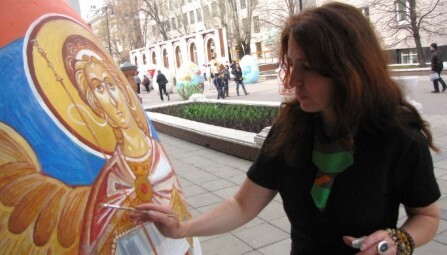
The first – and so far the only – Russian artist and designer for luxury European brands of decorative objects, Evgenia Miroshnichenko, known to art historians and museums the world over under the name Evgenia Miro, long ago defined for herself the chief element in the perception of Russian style: its many-faceted, fairytale quality.
When she began working with the French fashion house Hermès on a collection of scarves inspired by Russian culture, Evgenia proposed a design based on the Russian alphabet for her very first scarf. Each letter was represented through the image of a mythical bird.
“All the characters featured on the scarf are birds and mythological creatures inspired by Russian fairy tales and legends, whose images can be found in the bas-reliefs of historic buildings, everyday household objects, and pieces of jewellery,” - the designer explains.
The scarf, entitled Alphabet russe, first captured the imagination of design professionals and later won over the wider French public with its refinement and its palette.
When she began working with the French fashion house Hermès on a collection of scarves inspired by Russian culture, Evgenia proposed a design based on the Russian alphabet for her very first scarf. Each letter was represented through the image of a mythical bird.
“All the characters featured on the scarf are birds and mythological creatures inspired by Russian fairy tales and legends, whose images can be found in the bas-reliefs of historic buildings, everyday household objects, and pieces of jewellery,” - the designer explains.
The scarf, entitled Alphabet russe, first captured the imagination of design professionals and later won over the wider French public with its refinement and its palette.
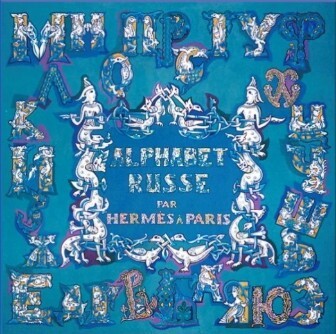
“For me, Russian culture is defined by its fairy-tale quality, of many-sidedness, and its uniqueness. Its diversity lies precisely in its many layers of symbolism. From the very beginning, I decided to use the magical bird as a symbolic image in my design. The bird, after all, is a talisman and a protector of the clan. As early as 2005, the House of Hermès, with which I was working, began to prepare a collection for the cross-cultural year of Russia and France. That is why, for my next work, I was again asked to use Russian motifs,” - Evgenia Miro recalls.
The scholarly study and elaboration of traditional folklore symbols began at the start of the nineteenth century with the research of the Russian historian and ethnographer Nikolai Ivanovich Kostomarov, who was the first to take an interest in the magical images of fairy tales and epic poems. Since then, their number has multiplied many times over. In Evgenia's view, such a diversity, such a depth of meaning and many-sidedness as are found in the multi-ethnic folklore of Russia exist nowhere else in the world. And for this reason, the source of inspiration for an artist who creates works rooted in the folk style is inexhaustible.
In 2009, Parisian fashionistas saw the scarf “Zabavushka”, in which the Cyrillic alphabet was likewise used in the spelling of the word. Incidentally, it was the version selected by Hermès from several designs proposed by the artist. The composition of the scarf, dynamic and intricate, revealed all the richness of the Russian folk toy, and, first and foremost, of the little horse, a symbol of the immortality of the family line. Evgenia drew her inspiration for the creation of the design at the Moscow children's toy museum “Zabavushka”, to which she made a special journey in order to see authentic examples of folk craftsmanship. The scarf became so popular that for many years the author was called Madame Zabavushka.
The scholarly study and elaboration of traditional folklore symbols began at the start of the nineteenth century with the research of the Russian historian and ethnographer Nikolai Ivanovich Kostomarov, who was the first to take an interest in the magical images of fairy tales and epic poems. Since then, their number has multiplied many times over. In Evgenia's view, such a diversity, such a depth of meaning and many-sidedness as are found in the multi-ethnic folklore of Russia exist nowhere else in the world. And for this reason, the source of inspiration for an artist who creates works rooted in the folk style is inexhaustible.
In 2009, Parisian fashionistas saw the scarf “Zabavushka”, in which the Cyrillic alphabet was likewise used in the spelling of the word. Incidentally, it was the version selected by Hermès from several designs proposed by the artist. The composition of the scarf, dynamic and intricate, revealed all the richness of the Russian folk toy, and, first and foremost, of the little horse, a symbol of the immortality of the family line. Evgenia drew her inspiration for the creation of the design at the Moscow children's toy museum “Zabavushka”, to which she made a special journey in order to see authentic examples of folk craftsmanship. The scarf became so popular that for many years the author was called Madame Zabavushka.
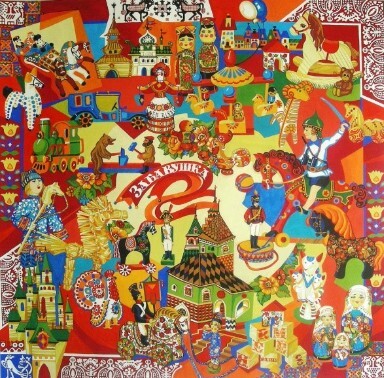
Following this success, whenever Evgenia Miro collaborated with other fashion houses and luxury brands, she was almost invariably asked to create designs rooted in a national style. The motif of the toy horse, a symbol of carefree childhood, continued to appear nostalgically in many of her later works. Thus, on one of the scarves she designed for an Italian fashion house in 2014, a magical travelling horse became the central character.
“In the design of the scarf, there I am as a little girl on the horse, there is the Firebird, and the Whale-Fish. Our little horse journeys across the world together with all its fairytale heroes and little birds,” - the artist explains.
Looking at Evgenia Miro's magical little horse, one can't help but think of a famous Russian children's poem by Agnia Barto:
I love my little horse so much,
I'll brush its coat with gentle touch,
Comb its tail so neat and bright,
Then ride to visit friends tonight.
At first, Evgenia was reluctant to accept the role of a “national fairy-tale artist”, as she longed for greater creative diversity.
“All the brands kept steering me towards Russian culture, which felt very strange to me. I work in many different styles, and it saddened me that everyone saw me solely as a folklorist and storyteller who was expected to produce something in a folk style. However, after several years and many collections later, I came to understand that, just as Sergei Diaghilev had a mission a century ago to promote the Russian culture of his time, I too carry a great responsibility: to create contemporary design based on the traditional cultural code of my nation. And one must give the French their due: they work with a national culture only through a representative of that very country,” - Evgenia recalls.
“In the design of the scarf, there I am as a little girl on the horse, there is the Firebird, and the Whale-Fish. Our little horse journeys across the world together with all its fairytale heroes and little birds,” - the artist explains.
Looking at Evgenia Miro's magical little horse, one can't help but think of a famous Russian children's poem by Agnia Barto:
I love my little horse so much,
I'll brush its coat with gentle touch,
Comb its tail so neat and bright,
Then ride to visit friends tonight.
At first, Evgenia was reluctant to accept the role of a “national fairy-tale artist”, as she longed for greater creative diversity.
“All the brands kept steering me towards Russian culture, which felt very strange to me. I work in many different styles, and it saddened me that everyone saw me solely as a folklorist and storyteller who was expected to produce something in a folk style. However, after several years and many collections later, I came to understand that, just as Sergei Diaghilev had a mission a century ago to promote the Russian culture of his time, I too carry a great responsibility: to create contemporary design based on the traditional cultural code of my nation. And one must give the French their due: they work with a national culture only through a representative of that very country,” - Evgenia recalls.
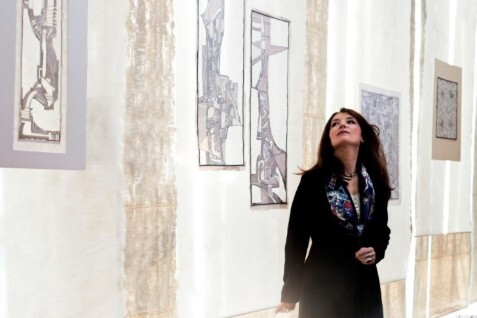
According to Evgenia Miro, no one has matched the scale and international impact of Sergei Diaghilev in promoting Russian culture abroad. Beginning in 1908 with the first 'Russian Season' of the world's most celebrated impresario, interest in the Russian style across the world has never abated. The Russian avant-garde, brought to Europe by émigré artists, followed by the Constructivist movement of the 1920s, helped shape the dominant trends in design and architecture throughout much of the twentieth century. Evgenia notes that the renowned French modernist architect Le Corbusier drew inspiration, among other sources, from the Russian avant-garde. The Russian style was loved by many Parisian couturiers.
“Yves Saint Laurent said that his favourite collection was the Russian collection he created. Jean Paul Gaultier incorporated Russian Constructivism into his work. He reimagined the traditional ushanka hat in a remarkably elegant way, fashioning it from black raven and embroidering the inside with beads.
One of the House of Chanel collections from 2017 features four pieces of jewellery bearing the names of the Russian men with whom Coco had relationships: Sergueï (Diaghilev), Dimitri (Grand Duke Dmitry Pavlovich Romanov), Igor (the composer Stravinsky), and Vaslav (the ballet dancer Nijinsky). Then, in 2019, Chanel launched Le Paris Russe de Chanel (‘Russian Paris by Chanel’), comprising sixty-three unique pieces of jewellery in the Russian style,” - Evgenia Miro enumerates.
“Yves Saint Laurent said that his favourite collection was the Russian collection he created. Jean Paul Gaultier incorporated Russian Constructivism into his work. He reimagined the traditional ushanka hat in a remarkably elegant way, fashioning it from black raven and embroidering the inside with beads.
One of the House of Chanel collections from 2017 features four pieces of jewellery bearing the names of the Russian men with whom Coco had relationships: Sergueï (Diaghilev), Dimitri (Grand Duke Dmitry Pavlovich Romanov), Igor (the composer Stravinsky), and Vaslav (the ballet dancer Nijinsky). Then, in 2019, Chanel launched Le Paris Russe de Chanel (‘Russian Paris by Chanel’), comprising sixty-three unique pieces of jewellery in the Russian style,” - Evgenia Miro enumerates.
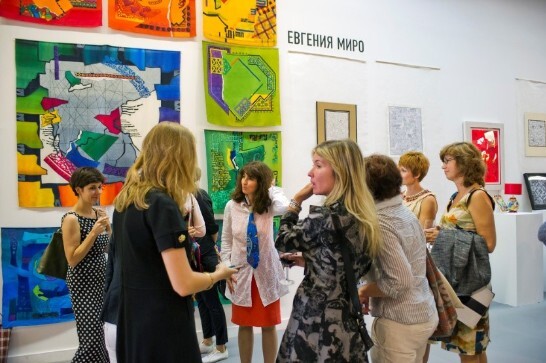
Despite this enduring interest in Russia, Europeans still possess only a relatively superficial knowledge of Russian culture, the designer argues. In literature, the most widely recognised Russian author remains Boris Pasternak, largely through his novel Doctor Zhivago. In the visual arts, the names most familiar to European audiences are Kazimir Malevich and, to a lesser extent, Marc Chagall.
In Evgenia's view, one reason for this limited awareness is the enormous cost of organising major exhibitions of Russian art abroad. A single painting by Mikhail Vrubel or Valentin Serov, or even a dedicated exhibition of Ilya Repin, is not enough.
What is needed is a full-scale, systematic effort of engagement with the European creative intelligentsia, with lovers of art, in order to reveal the entire grandeur of the Russian artistic school. The designer also has words of reproach for those working in cultural enlightenment within Russia itself.
“Who in Russia today knows the name Fyodor Solntsev? And yet he was the founder of the Russian style,” says Evgenia.
It was thanks to Fyodor Solntsev and the sketches he produced during his expeditions that the design of many traditional Russian household objects was preserved and later reconstructed. By the early 1830s, Old Russian heritage was in a deplorable state. It had been nearly destroyed by fires, renovations and the fashion for all things European. The surviving fragments of cultural artifacts were neither documented nor systematically classified. Solntsev worked most successfully with ornamental design and decorative arts and had a strong influence on nineteenth-century Russian design. His sketches of ancient Russian patterns, enamelwork, and textiles became the standard for architects, jewelers, and designers. As a result, his interpretation of the “Russian style” came to be perceived as an authentic national style, although in reality it was an artistic reconstruction.
In Evgenia's view, one reason for this limited awareness is the enormous cost of organising major exhibitions of Russian art abroad. A single painting by Mikhail Vrubel or Valentin Serov, or even a dedicated exhibition of Ilya Repin, is not enough.
What is needed is a full-scale, systematic effort of engagement with the European creative intelligentsia, with lovers of art, in order to reveal the entire grandeur of the Russian artistic school. The designer also has words of reproach for those working in cultural enlightenment within Russia itself.
“Who in Russia today knows the name Fyodor Solntsev? And yet he was the founder of the Russian style,” says Evgenia.
It was thanks to Fyodor Solntsev and the sketches he produced during his expeditions that the design of many traditional Russian household objects was preserved and later reconstructed. By the early 1830s, Old Russian heritage was in a deplorable state. It had been nearly destroyed by fires, renovations and the fashion for all things European. The surviving fragments of cultural artifacts were neither documented nor systematically classified. Solntsev worked most successfully with ornamental design and decorative arts and had a strong influence on nineteenth-century Russian design. His sketches of ancient Russian patterns, enamelwork, and textiles became the standard for architects, jewelers, and designers. As a result, his interpretation of the “Russian style” came to be perceived as an authentic national style, although in reality it was an artistic reconstruction.
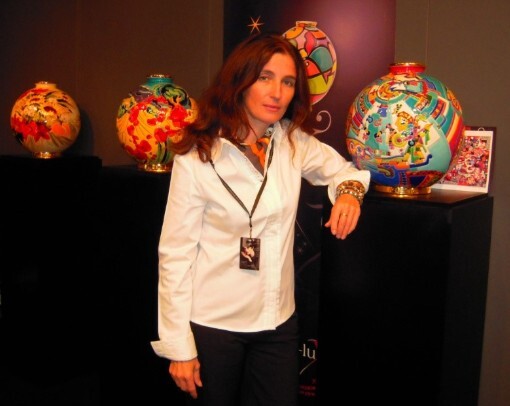
“The fusion of Russian traditions with contemporary design is an ongoing process. In my view, many people in Russia have an incorrect approach to folk art. Simply reproducing traditional motifs and placing them on modern objects is not enough. There must be a unity of different stylistic elements within a single concept. Taking the image of a folk craft as one's point of departure, it is essential to find a new stylistic resolution and to embody it in a given form, taking into account the technological possibilities and the production cycle,” - Evgenia Miro believes.
Just as church frescoes and icons once served as a kind of Bible for those who could not read, visual art today communicates the culture of a nation to people who do not speak its language. who do not know the Russian language. And figurative folk art, upon which contemporary artists and designers might draw in their own creative work, does this better than anything else.
Just as church frescoes and icons once served as a kind of Bible for those who could not read, visual art today communicates the culture of a nation to people who do not speak its language. who do not know the Russian language. And figurative folk art, upon which contemporary artists and designers might draw in their own creative work, does this better than anything else.