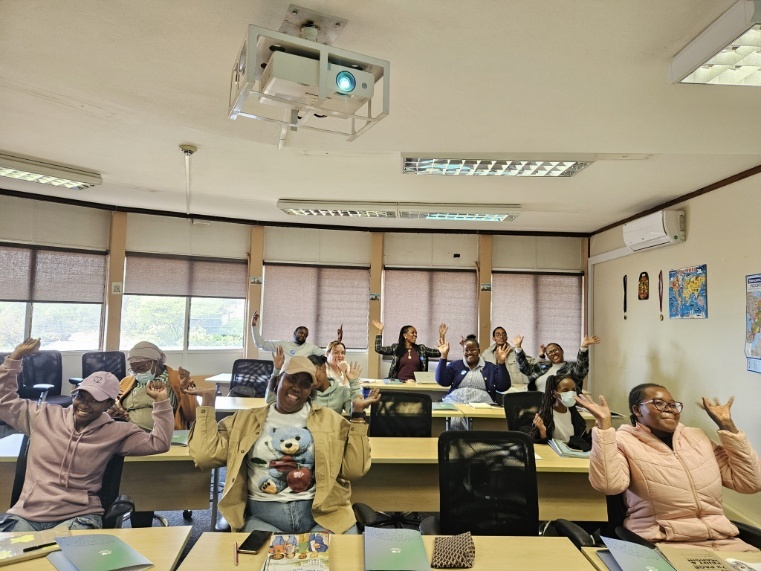
The Russian language classroom, or simply the Russian Class, is one of the most interesting places at the University of South Africa (UNISA) in Pretoria, the largest university on the African continent. From time to time, Russian songs and echoes of Russian festivals can be heard coming from the room, and sometimes the aroma of Russian cuisine wafts through the air. The classroom was decorated in Russian style by Anna Dolinger, a teacher from the Preparatory Department for Foreign Citizens at Tyumen State University (TyumGU).
In her lessons, the Siberian teacher breaks down students’ stereotypes about Russia - and parts with some of her own about Africa. For example, about the local winter. Anna told “Russkiy Mir” about how young people in South Africa are showing interest in the Russian language and in studying in Russia.
Winning hearts for Russia
- Anna, tell us about the project through which you are working in South Africa
- The project is called “Information and Methodological Support for Russian Language Courses in Southern African Countries”. Its participants are UNISA (University of South Africa), TyumGU and RUDN University, with the support of the Russian Ministry of Education.
- What motivates students in South Africa to study Russian?
- It is difficult to say precisely what motivates them to take up the study of the language. I can only suppose that it is interest. They study within the Faculty of Linguistics, so they already possess an inclination for languages. For many South Africans, Russia is something entirely distant, unknown, and alien, yet it is constantly on their radar, since political news is frequently broadcast on local radio. I do everything in my power to break down their stereotypes, to awaken an interest in the culture, and to make them fall in love with Russia.
- How did you choose your profession?
- I graduated from TyumGU. My choice of profession was influenced by a student exchange trip to Serbia. For an entire year I studied Serbian in an international group and for the first time thought that this was something I really enjoyed and would like to do — working with foreigners.
- How did the opportunity to go to South Africa come about?
- I first visited South Africa last year as part of this same project. During the holidays, NataliaNikolaevna Dzida, head of the preparatory department where I work, suggested I take part in this interesting project. At that time, I already had about 5–6 years of experience teaching Russian as a Foreign Language. I had worked for a year at a university in China, and my English language skills were an advantage. I had already been to Europe, China and South America. I really wanted to visit Africa too.
In her lessons, the Siberian teacher breaks down students’ stereotypes about Russia - and parts with some of her own about Africa. For example, about the local winter. Anna told “Russkiy Mir” about how young people in South Africa are showing interest in the Russian language and in studying in Russia.
Winning hearts for Russia
- Anna, tell us about the project through which you are working in South Africa
- The project is called “Information and Methodological Support for Russian Language Courses in Southern African Countries”. Its participants are UNISA (University of South Africa), TyumGU and RUDN University, with the support of the Russian Ministry of Education.
- What motivates students in South Africa to study Russian?
- It is difficult to say precisely what motivates them to take up the study of the language. I can only suppose that it is interest. They study within the Faculty of Linguistics, so they already possess an inclination for languages. For many South Africans, Russia is something entirely distant, unknown, and alien, yet it is constantly on their radar, since political news is frequently broadcast on local radio. I do everything in my power to break down their stereotypes, to awaken an interest in the culture, and to make them fall in love with Russia.
- How did you choose your profession?
- I graduated from TyumGU. My choice of profession was influenced by a student exchange trip to Serbia. For an entire year I studied Serbian in an international group and for the first time thought that this was something I really enjoyed and would like to do — working with foreigners.
- How did the opportunity to go to South Africa come about?
- I first visited South Africa last year as part of this same project. During the holidays, NataliaNikolaevna Dzida, head of the preparatory department where I work, suggested I take part in this interesting project. At that time, I already had about 5–6 years of experience teaching Russian as a Foreign Language. I had worked for a year at a university in China, and my English language skills were an advantage. I had already been to Europe, China and South America. I really wanted to visit Africa too.
- What do you see as the aim of your work abroad?
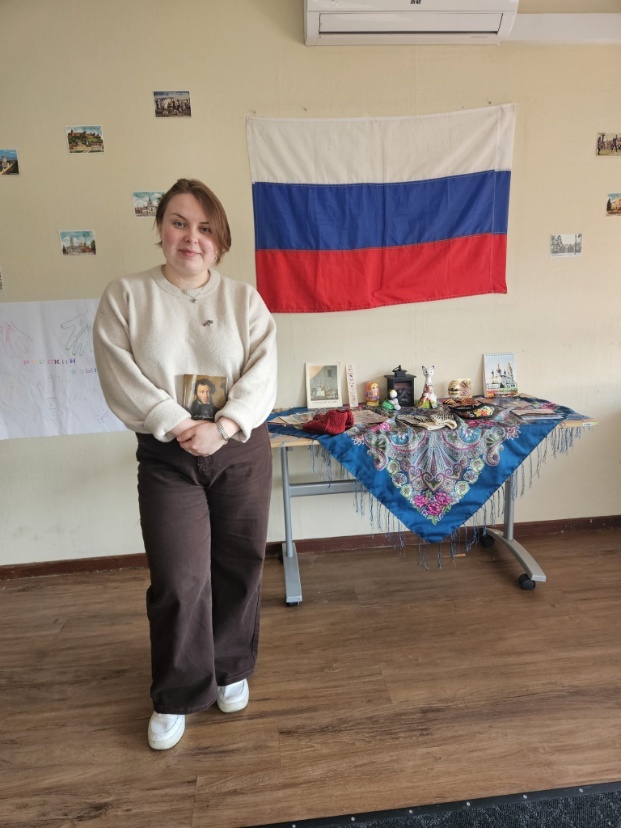
- I have a concrete task before me: to foster a positive attitude towards Russia, to awaken an interest in studying the Russian language, and to attract as many people as possible who wish to become acquainted with Russia.
The Russian classroom – here the students feel at ease
- What curricula do you work with? How do the lessons proceed?
- The team at the Preparatory Department of Tyumen State University specially developed a textbook, a workbook, and a supplementary online course on the interactive platform Stepik specially for this project. The textbook is very colourful and culturally oriented. The textbook turned out to be wonderfully colourful and ethno-oriented. The students enjoy working not with online materials, pdfs, or PowerPoint presentations, but with a textbook they can hold in their hands, leaf through, and complete tasks in a workbook. They are highly satisfied. And I like the fact that I already have ready-made material, which I can dilute slightly with communicative or grammar exercises as needed. Since I, too, took part in the development of all the teaching materials, it is doubly pleasing for me to see the fruits of our labour in action and the happy faces of the students.
At UNISA, we decorated the classroom together with the students and created the Russian Classroom. There is a Russian flag, a map of Russia, Russian banknotes, mittens, a traditional patterned shawl, souvenirs, items painted in Gzhel and Khokhloma styles, and cards featuring Russian cities. It turned out really well! Lessons take place in this classroom in a very relaxed and friendly atmosphere. The students feel comfortable and are making good progress in learning Russian.
- How do the students perceive the material? What do they find particularly difficult?
- Naturally, the Russian language does not come easily to them, but that is absolutely normal. What was difficult for them at the beginning has now become much easier. It is very important to point out their progress and achievements and to encourage them. They are proud of themselves. The material is presented systematically and sequentially according to established teaching methodology, so I cannot say that I feel any major difference between working in Russia and in South Africa.
- I have a concrete task before me: to foster a positive attitude towards Russia, to awaken an interest in studying the Russian language, and to attract as many people as possible who wish to become acquainted with Russia.
The Russian classroom – here the students feel at ease
- What curricula do you work with? How do the lessons proceed?
- The team at the Preparatory Department of Tyumen State University specially developed a textbook, a workbook, and a supplementary online course on the interactive platform Stepik specially for this project. The textbook is very colourful and culturally oriented. The textbook turned out to be wonderfully colourful and ethno-oriented. The students enjoy working not with online materials, pdfs, or PowerPoint presentations, but with a textbook they can hold in their hands, leaf through, and complete tasks in a workbook. They are highly satisfied. And I like the fact that I already have ready-made material, which I can dilute slightly with communicative or grammar exercises as needed. Since I, too, took part in the development of all the teaching materials, it is doubly pleasing for me to see the fruits of our labour in action and the happy faces of the students.
At UNISA, we decorated the classroom together with the students and created the Russian Classroom. There is a Russian flag, a map of Russia, Russian banknotes, mittens, a traditional patterned shawl, souvenirs, items painted in Gzhel and Khokhloma styles, and cards featuring Russian cities. It turned out really well! Lessons take place in this classroom in a very relaxed and friendly atmosphere. The students feel comfortable and are making good progress in learning Russian.
- How do the students perceive the material? What do they find particularly difficult?
- Naturally, the Russian language does not come easily to them, but that is absolutely normal. What was difficult for them at the beginning has now become much easier. It is very important to point out their progress and achievements and to encourage them. They are proud of themselves. The material is presented systematically and sequentially according to established teaching methodology, so I cannot say that I feel any major difference between working in Russia and in South Africa.
“I wasn’t prepared for an African winter”
- Was it nerve-wracking to go for the first time? What worried you the most?
- Of course, I was very anxious. The first time, my secondment was only for a fortnight. While preparing, I read a lot of articles about South Africa. They wrote about high crime rates, power cuts several times a day with no set schedule, advice not to appear in the city centre, to travel only by the most expensive taxis, not to carry valuables, and especially not to show your phone on the street.
Naturally, the financial question posed a problem, since Russian bank cards do not work here and I had to travel with cash. Beyond these everyday concerns, I was required to conduct ten cultural and educational events over the course of the fortnight. I did not know what would be available on the spot, so I carried everything with me – from felt-tip pens and paper to sweets and biscuits. I worried about everything, yet I set off prepared for any eventuality. The whole team helped to get me ready for the trip.
- How did South Africa greet you?
- I was very fortunate, because I did not encounter any poor treatment or anything negative of the kind they write about on the internet. People here are very warm, helpful, and always interested in where I’m from. They ask how to say “hello” in Russian.
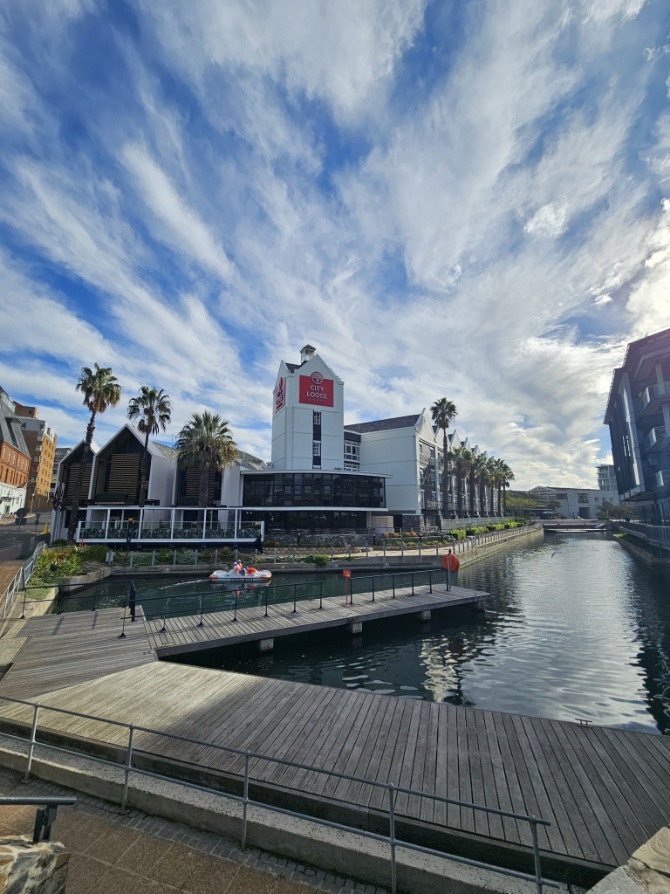
I cannot say that I experienced culture shock, because I have been working with Africans for a long time now and am already acquainted with many cultural particularities. Of course, eating with one's hands or eating insects will always remain strange to me. Perhaps the most unusual thing for me is feeling cold in Africa. It is winter in South Africa at present. Their winter resembles our cooler summer: the daytime temperature does not rise above twenty-five degrees, and at night it can drop as low as six. Yet inside the houses, at the university, in the hotel, it is very cold. You know, nineteen degrees in Tyumen is quite a comfortable temperature for me, but here I am freezing. I have even bought myself warm pajamas, two jumpers, and thick socks, because I turned out to be entirely unprepared for the African winter. Outdoors here, it is warmer than indoors. At the university and at home, people go about in jackets because the buildings do not get heated. There were several nights when I had to sleep under two blankets, in warm pajamas and two pairs of socks.
- What else did you have to get used to?
- I must admit, the local food is not quite to my taste, because everything here is fried in a great deal of oil, salty, and heavily spiced. I am not fond of such things, though I suppose it is a matter of taste. I miss syrniki (these are traditional Slavic mini pancakes made from cottage cheese, which are usually eaten for breakfast or as a dessert). Fortunately, I am able to cook for myself, so I do not suffer at the hands of the local cuisine. They say that South African wines are of very good quality, but I am utterly indifferent to that and cannot tell the difference.
Probably the biggest challenge for me is the lack of shops within walking distance. People usually drive to the supermarket, do a big weekly shop and that’s it. I don’t have a car, so I have to order a taxi every time. Since I live quite far from the city centre, sometimes the taxi ride costs more than the groceries themselves. Once I needed salt to make salt dough for an event – I had to make a special trip to the supermarket just for a packet of salt. It was the most expensive salt I’ve ever bought in my life. Overall, I have adapted. Of course there are difficulties, but they are mostly related to work processes rather than everyday life.
- Was it nerve-wracking to go for the first time? What worried you the most?
- Of course, I was very anxious. The first time, my secondment was only for a fortnight. While preparing, I read a lot of articles about South Africa. They wrote about high crime rates, power cuts several times a day with no set schedule, advice not to appear in the city centre, to travel only by the most expensive taxis, not to carry valuables, and especially not to show your phone on the street.
Naturally, the financial question posed a problem, since Russian bank cards do not work here and I had to travel with cash. Beyond these everyday concerns, I was required to conduct ten cultural and educational events over the course of the fortnight. I did not know what would be available on the spot, so I carried everything with me – from felt-tip pens and paper to sweets and biscuits. I worried about everything, yet I set off prepared for any eventuality. The whole team helped to get me ready for the trip.
- How did South Africa greet you?
- I was very fortunate, because I did not encounter any poor treatment or anything negative of the kind they write about on the internet. People here are very warm, helpful, and always interested in where I’m from. They ask how to say “hello” in Russian.
I cannot say that I experienced culture shock, because I have been working with Africans for a long time now and am already acquainted with many cultural particularities. Of course, eating with one's hands or eating insects will always remain strange to me. Perhaps the most unusual thing for me is feeling cold in Africa. It is winter in South Africa at present. Their winter resembles our cooler summer: the daytime temperature does not rise above twenty-five degrees, and at night it can drop as low as six. Yet inside the houses, at the university, in the hotel, it is very cold. You know, nineteen degrees in Tyumen is quite a comfortable temperature for me, but here I am freezing. I have even bought myself warm pajamas, two jumpers, and thick socks, because I turned out to be entirely unprepared for the African winter. Outdoors here, it is warmer than indoors. At the university and at home, people go about in jackets because the buildings do not get heated. There were several nights when I had to sleep under two blankets, in warm pajamas and two pairs of socks.
- What else did you have to get used to?
- I must admit, the local food is not quite to my taste, because everything here is fried in a great deal of oil, salty, and heavily spiced. I am not fond of such things, though I suppose it is a matter of taste. I miss syrniki (these are traditional Slavic mini pancakes made from cottage cheese, which are usually eaten for breakfast or as a dessert). Fortunately, I am able to cook for myself, so I do not suffer at the hands of the local cuisine. They say that South African wines are of very good quality, but I am utterly indifferent to that and cannot tell the difference.
Probably the biggest challenge for me is the lack of shops within walking distance. People usually drive to the supermarket, do a big weekly shop and that’s it. I don’t have a car, so I have to order a taxi every time. Since I live quite far from the city centre, sometimes the taxi ride costs more than the groceries themselves. Once I needed salt to make salt dough for an event – I had to make a special trip to the supermarket just for a packet of salt. It was the most expensive salt I’ve ever bought in my life. Overall, I have adapted. Of course there are difficulties, but they are mostly related to work processes rather than everyday life.
“For some people, Russia is like another planet”
– Russia is probably something of a mystery to people in South Africa. What are local people most curious about?
– They often ask about the conflict in Ukraine. In those situations, it is important to explain gently that politics is not the most suitable topic for discussion, and switch to another. Not once has there been any problem with this. They also frequently ask about winter. People say: “You are from Siberia, so why do you feel cold in Africa?”. But I always answer with pride that a Siberian is not someone who never feels the cold, but someone who loves warmth and dresses warmly.
For some people, Russia is almost like another planet. They know very little about the country. They have heard of Vladimir Putin, they believe that Russia is always freezing cold, and, of course, they know about the bears.
– How do you introduce your students to Russia and its culture?
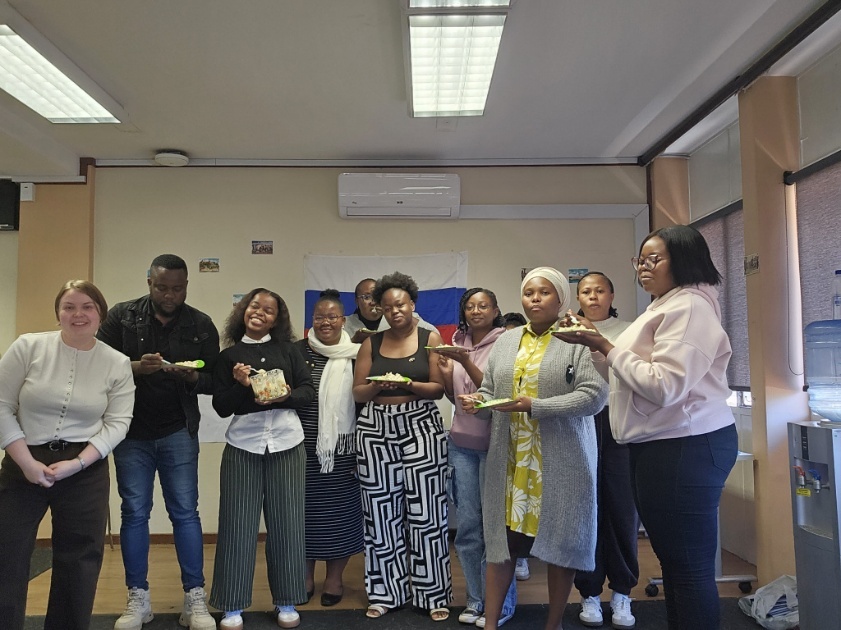
– During our cultural events, we have prepared Olivier salad, read Alexander Pushkin in both the original Russian and in translation, made traditional Russian souvenirs from salt dough, sung Russian songs, and performed folk dances. There is still a great deal of interesting things to come. Both students and guests find it fascinating to acquaint themselves with Russian culture, because the events are not held in a lecture format but unfailingly involve some kind of interactivity: quizzes, dancing, songs, food, games, and so on.
– How do your students respond to you? How does your interaction with them unfold?
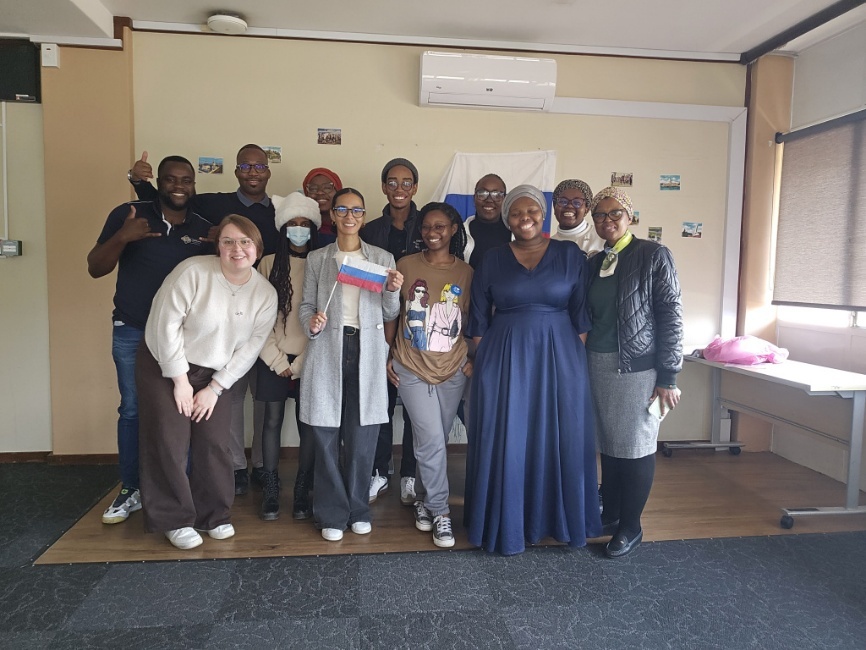
– My students have always welcomed me warmly; I have never encountered hostility. At first they took a closer look at me, but they quickly grew accustomed to me. I am a very open person and treat my students as equals, always showing respect for them and for their culture. They are not afraid of me – they trust me – and as a result, our lessons and our conversations are consistently positive.
– Russia is probably something of a mystery to people in South Africa. What are local people most curious about?
– They often ask about the conflict in Ukraine. In those situations, it is important to explain gently that politics is not the most suitable topic for discussion, and switch to another. Not once has there been any problem with this. They also frequently ask about winter. People say: “You are from Siberia, so why do you feel cold in Africa?”. But I always answer with pride that a Siberian is not someone who never feels the cold, but someone who loves warmth and dresses warmly.
For some people, Russia is almost like another planet. They know very little about the country. They have heard of Vladimir Putin, they believe that Russia is always freezing cold, and, of course, they know about the bears.
– How do you introduce your students to Russia and its culture?
– During our cultural events, we have prepared Olivier salad, read Alexander Pushkin in both the original Russian and in translation, made traditional Russian souvenirs from salt dough, sung Russian songs, and performed folk dances. There is still a great deal of interesting things to come. Both students and guests find it fascinating to acquaint themselves with Russian culture, because the events are not held in a lecture format but unfailingly involve some kind of interactivity: quizzes, dancing, songs, food, games, and so on.
– How do your students respond to you? How does your interaction with them unfold?
– My students have always welcomed me warmly; I have never encountered hostility. At first they took a closer look at me, but they quickly grew accustomed to me. I am a very open person and treat my students as equals, always showing respect for them and for their culture. They are not afraid of me – they trust me – and as a result, our lessons and our conversations are consistently positive.
– Do you keep in touch with colleagues and with the Russian-speaking residents of Pretoria?
– My colleagues at UNISA are very supportive and provide all the necessary assistance. We are currently planning to open a weekend school for the children of compatriots. Of course, all discussions are held with the parents. They want their children to preserve the Russian language, so they are very interested in cooperation.
– And do many people in South Africa know the Russian language?
– Yes, I have met quite a few people who speak Russian. Firstly, there is a Russian church not far from Pretoria with a large community of compatriots who, for various reasons, have ended up in South Africa. We are also in contact with the Coordination Council of Russian Compatriots’ Organisations (KSORS). The Russian Embassy helps us as well. Secondly, I know some graduates of Russian universities. They are very positive young people who are always happy to get in touch.
– Do you notice any interest in Russian education among young people?
– Students are very interested in academic programmes and grants. Within the framework of the project, outreach work is being carried out in which we (myself and my colleague from RUDN University) speak about Russian universities and scientific achievements. We are trying to cultivate this interest.
– In your opinion, how is Russian culture represented in South Africa? For example, can one buy books in Russian or about Russia?
– Yes, I have seen a book about Rasputin and the Romanovs on sale, although the author was not Russian. The KSORS and the Embassy organise cultural events and try to support the Russian-speaking community and develop our culture. I know there are Russian schools here. It is heartening that our compatriots, in various ways, are working towards the development of culture and the enlightenment of the population. It is pleasant to find oneself counted among their number.
– My colleagues at UNISA are very supportive and provide all the necessary assistance. We are currently planning to open a weekend school for the children of compatriots. Of course, all discussions are held with the parents. They want their children to preserve the Russian language, so they are very interested in cooperation.
– And do many people in South Africa know the Russian language?
– Yes, I have met quite a few people who speak Russian. Firstly, there is a Russian church not far from Pretoria with a large community of compatriots who, for various reasons, have ended up in South Africa. We are also in contact with the Coordination Council of Russian Compatriots’ Organisations (KSORS). The Russian Embassy helps us as well. Secondly, I know some graduates of Russian universities. They are very positive young people who are always happy to get in touch.
– Do you notice any interest in Russian education among young people?
– Students are very interested in academic programmes and grants. Within the framework of the project, outreach work is being carried out in which we (myself and my colleague from RUDN University) speak about Russian universities and scientific achievements. We are trying to cultivate this interest.
– In your opinion, how is Russian culture represented in South Africa? For example, can one buy books in Russian or about Russia?
– Yes, I have seen a book about Rasputin and the Romanovs on sale, although the author was not Russian. The KSORS and the Embassy organise cultural events and try to support the Russian-speaking community and develop our culture. I know there are Russian schools here. It is heartening that our compatriots, in various ways, are working towards the development of culture and the enlightenment of the population. It is pleasant to find oneself counted among their number.